The emergence of commercially accessible artificial intelligence capabilities in 2022 and 2023 created a new research question for construction technology: what specific AI capabilities were relevant to construction documentation and compliance, and what infrastructure was required to deploy them effectively in construction field environments?
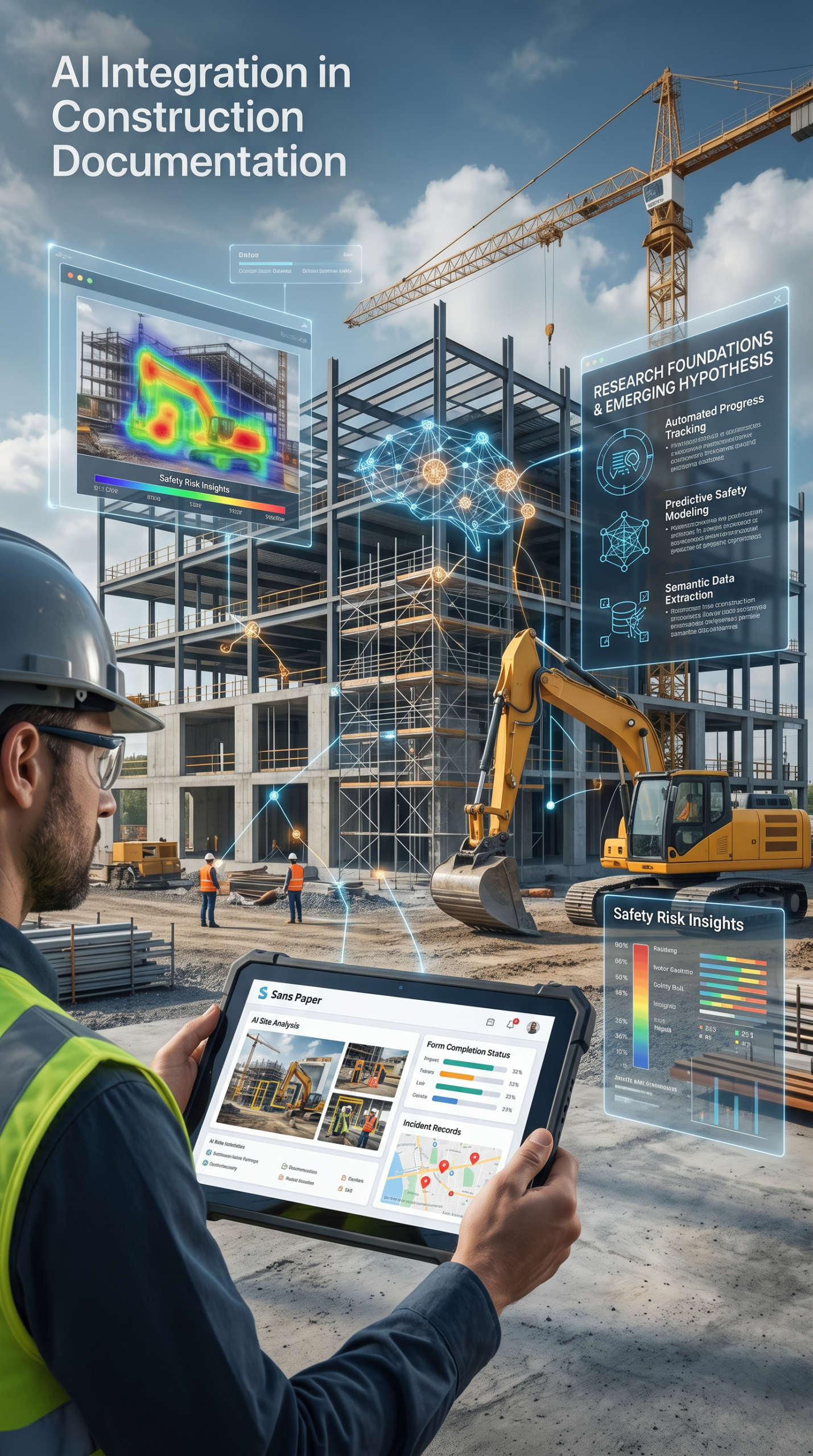
This question was not abstract for Vertical Matters. The Sans Paper platform was already generating construction field data, photographs, form completions, incident records, inspection notes, at volume. The research question became whether AI analysis of that data could produce safety insights that human review could not generate within practical time and resource constraints.
The initial hypothesis was that photo analysis represented the most accessible AI integration point. Construction sites generate photographs continuously, progress documentation, defect records, safety observations, equipment condition reporting. Human review of those photographs produces inconsistent safety insights because reviewer attention, expertise, and bandwidth are variable. AI analysis, applied consistently to every photograph in the dataset, could in principle identify safety indicators that individual reviewers would miss.
The research challenge is not the AI capability itself. Commercially available computer vision systems are capable of the analysis described. The research challenge is construction-domain specificity: a general purpose image classifier trained on broad datasets does not reliably identify construction safety indicators without construction specific training data and query architecture.
Vertical Matters research into this area established that construction specific AI deployment requires a purpose built data pipeline: photographs tagged with construction context, incident data linked to specific documentation events and a query architecture that asks construction relevant questions of the AI system rather than general purpose visual queries.
Building that pipeline is the current phase of research. The hypothesis is that AI assisted safety analytics can identify risk patterns invisible to human review, remains unproven at scale. Testing it is the work.